.png)
 简体中文

Analog vs Digital Audio Recording: Key Differences, Sound Quality, and How to Choose
For decades, analog versus digital audio has fueled studio debates. Musicians still compare tape machines with modern DAW recording setups. Audio students also face this choice while learning recording fundamentals. Podcasters encounter it when picking their first recording setup. Neither format is perfect, and both bring different strengths.
This guide compares their technical differences without overselling either side. It also tackles the whole “analog warmth” debate directly. You will also get a practical way to choose wisely. The right choice depends on your specific recording needs.

What Is Analog Audio Recording?
Analog recording captures sound as a continuous, uninterrupted electrical signal that mirrors the physical pressure variations of sound waves. Unlike digital systems that take periodic snapshots of a waveform, analog maintains a one-to-one correspondence between the original acoustic event and the stored representation. The word “analog” reflects this relationship directly: the recording is analogous to the original sound.

The most widely used analog storage medium is magnetic tape. In tape-based recording, the incoming electrical signal drives an electromagnetic recording head that reorganizes iron oxide or chromium dioxide particles on the tape surface.
The arrangement of these particles encodes the amplitude and frequency information of the original sound. When the tape passes over a playback head, the magnetic pattern induces a voltage that reconstructs the audio signal.
Key characteristics of analog recording:
- Continuous waveform: The signal is never broken into discrete steps; it represents the original sound as an uninterrupted electrical flow.
- Tape saturation: When the signal level pushes into the upper range of what tape can handle, the magnetic particles reach a saturation point. Rather than clipping abruptly, the signal compresses and introduces harmonic distortion in a way most engineers describe as pleasing.
- Tape compression: The natural limiting behavior of tape near saturation acts as gentle compression, smoothing transient peaks without the mechanical feel of a hardware compressor.
- Harmonic distortion: Tape introduces predominantly even-order harmonics, which blend consonantly with musical content.
- Noise floor: Every tape has a baseline of self-noise commonly called tape hiss. This noise floor sets the lower boundary of the usable dynamic range.
- Wow and flutter: Mechanical imperfections in the transport speed of a tape machine introduce subtle pitch instabilities. Wow refers to slow speed variation; flutter refers to faster, more rapid oscillations. Both can add an organic quality or become a flaw depending on the condition of the machine.
What Is Digital Audio Recording?
Digital recording turns continuous analog sound into numerical data. An analog-to-digital converter, or ADC, performs this conversion process. The ADC checks waveform amplitude at evenly spaced intervals. This process is known as sampling in digital recording. Each measurement receives a numerical value represented through binary code. During playback, a DAC converts those numbers back again. It rebuilds them into an electrical waveform for playback. Speakers or headphones can then reproduce that resulting waveform.

Two numbers define the resolution of a digital recording:
Sample rate determines how many amplitude measurements are taken per second. Common sample rates include:
- 44.1 kHz: 44,100 samples per second. The standard for CD-quality audio and most music streaming.
- 48 kHz: The broadcast and video production standard, used across film, television, and podcast delivery.
- 96 kHz and 192 kHz: High-resolution rates used in professional studio recording, capturing frequencies well above the human hearing range.
Bit depth determines how many distinct amplitude values can be assigned to each sample. More bits mean more granularity, which translates directly to dynamic range:
- 16-bit: 65,536 possible amplitude steps; approximately 96 dB of dynamic range. The consumer and CD standard.
- 24-bit: Over 16 million possible steps; approximately 144 dB of dynamic range. The professional studio standard.
- 32-bit float: A floating-point data format that decouples gain staging from clipping risk inside the recording device itself. The theoretical dynamic range is staggeringly wide, effectively making internal clipping non-destructive during recording.
The resulting audio data is stored as files. Lossless formats such as WAV, AIFF, and FLAC preserve every bit of the recorded data. Lossy formats like MP3 and AAC use perceptual compression to reduce file size by discarding audio information that human hearing is statistically least likely to detect. For recording and production, lossless formats are the professional standard; lossy formats are primarily a delivery format.
A digital audio workstation, or DAW, stores and processes digital recordings. It provides the space for editing, mixing, and processing. DAWs also support non-destructive editing without changing original recordings. You can add unlimited tracks while processing them with plugins. Sessions can also be recalled instantly whenever you need them. Analog tape workflows don’t offer direct equivalents to these capabilities.
Sound Quality: Analog Warmth vs. Digital Accuracy
Few debates in audio are as persistent as analog warmth versus digital accuracy. The conversation often produces more heat than light because both sides are partly right. They are describing different qualities, not competing on a single objective scale.
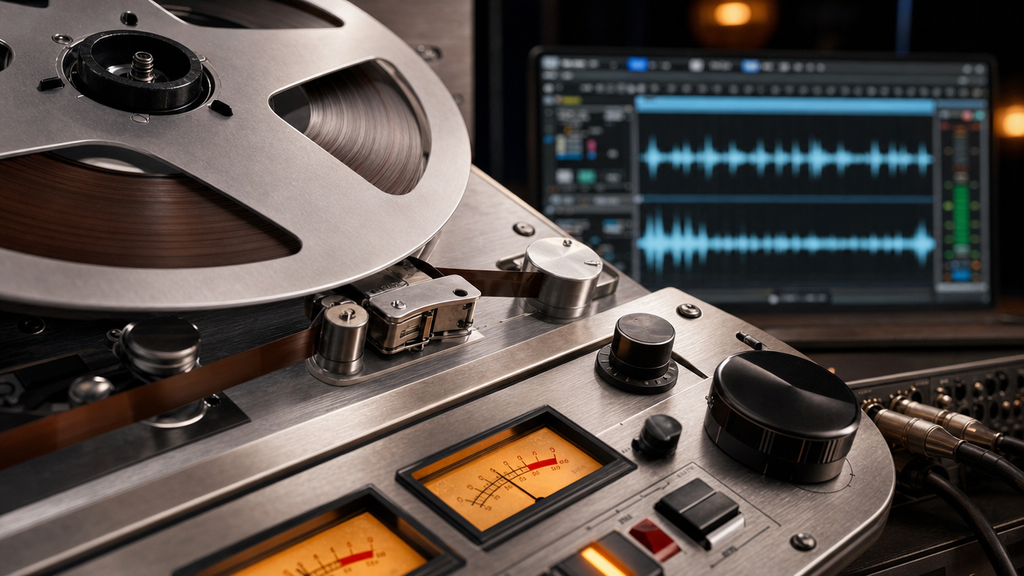
The Science Behind Analog Warmth
“Analog warmth” is not mythology, but it is also not magic. It has a specific physical cause: even-order harmonic distortion.
When audio passes through tape recording chains, extra content gets added. Magnetic tape adds 3rd and 5th harmonic overtones near saturation. These harmonics weren’t present within the original recorded signal. Tape machine amplifiers can also add even-order harmonics. These include 2nd and 4th harmonics within the recorded audio. Even-order harmonics relate mathematically to the fundamental frequency. Their ratios line up closely with natural musical intervals, especially octaves. This helps them blend smoothly with musical content. Instead of sounding harsh, they tend to sound consonant.
Alongside harmonic saturation, tape applies gentle natural compression. As a signal approaches the saturation threshold, the louder the signal becomes, the more the tape pulls the peaks back. This behaves similarly to a smooth analog compressor set to a medium attack and release, adding cohesion and density to recordings that engineers often describe as “glue.”
Tape also rolls off the extreme high frequencies slightly and introduces subtle low-frequency phase shift. Combined with the harmonic content, this creates a frequency profile that human ears have been conditioned to associate with recorded music, particularly in genres where warmth and physical impact carry the most weight: rock, blues, and jazz.
It’s worth getting specific about what’s actually happening here. What people call “analog warmth” is technically a type of distortion. It sounds pleasant because that distortion stays predictable and harmonically consonant. Compression also makes its behavior resemble natural acoustic patterns. The resulting character comes from physical limitations within analog equipment. It wasn’t deliberately added just to make recordings sound nicer.
Digital Transparency and Accuracy
Digital recording makes no such additions. An ideal digital signal chain captures what enters the microphone and reproduces it exactly on playback, within the constraints of its sample rate and bit depth.
The practical advantages of this accuracy are significant:
- High signal-to-noise ratio: Modern 24-bit and 32-bit digital recordings have noise floors that are, for practical purposes, inaudible in any normal listening environment. There is no tape hiss, no head noise, and no mechanical rumble.
- Flat frequency response: Digital introduces no frequency-dependent roll-off or phase shift within the audible range, assuming the sample rate is appropriate for the content.
- Zero generational loss: Copying a digital audio file produces a mathematically identical copy. Analog tape loses a small but audible amount of fidelity with each additional generation of dubbing.
- Scalable resolution: Recording engineers can select from 44.1 kHz to 192 kHz and from 16-bit to 32-bit float to match the resolution to the specific project requirement.
Some people call digital audio “cold” or “sterile,” but context matters. Early digital systems sometimes had poor conversion hardware inside. Low-quality ADC and DAC circuitry could affect the resulting sound. Personal taste also plays a role in these opinions. Some listeners simply prefer the harmonic color that tape creates. Modern high-quality digital recording doesn’t objectively sound cold or sterile. Instead, it reproduces audio with a high level of accuracy. Whether that accuracy suits your project depends on aesthetics. It isn’t necessarily evidence of a technical weakness.
Dynamic Range and Noise Floor — A Technical Comparison
Dynamic range is the distance between the quietest sound a system can capture and the loudest it can handle before distortion becomes problematic. This is one of the most quantifiable differences between analog and digital formats, and it has been revolutionized by the development of 32-bit float recording.
| Attribute | Analog (Tape) | Digital 16-bit | Digital 24-bit | Digital 32-bit Float |
|---|---|---|---|---|
| Dynamic Range | ~70 dB | ~96 dB | ~144 dB | ~1,528 dB (theoretical) |
| Noise Floor | Audible tape hiss | Low | Very low | Negligible |
| Clipping Behavior | Soft saturation | Hard clip | Hard clip | No clip (internal) |
| Headroom | Limited | Moderate | Wide | Virtually unlimited |
Analog tape typically offers around 60 to 70 dB of usable dynamic range. At the bottom of that range sits tape hiss; at the top, saturation. The behavior at the top is tape’s most forgiving characteristic. It does not clip abruptly. It compresses and saturates gradually, giving engineers room to push levels without catastrophic consequences.
Standard 16-bit digital recording achieves approximately 96 dB of dynamic range, which is measurably wider than tape. But its clipping behavior is the opposite of tape. At the digital ceiling, the signal hard clips, producing harsh square-wave distortion rather than gradual saturation. This made precise gain staging importantl in early digital workflows. A poorly set gain on a 16-bit system sounded far worse than an overdriven tape machine.
24-bit recording extended dynamic range to approximately 144 dB, which is wider than human hearing can perceive at any comfortable listening level. Clipping at the ceiling remains harsh, but the combination of increased headroom and a very low noise floor made 24-bit recording far more forgiving in practice.
32-bit float changed the fundamental rules for internal recording. In a 32-bit float system, the gain applied internally to the recorded signal is stored independently from the captured audio data. This means that even if a signal clips at the input stage, you can recover the internally stored representation in post-production without data loss. The dynamic range figure is theoretical rather than physical, but the practical result is a recording format where gain staging errors during capture are no longer permanent or destructive.
This matters most when setting gain ahead of time isn’t practical. Live events can make proper gain settings especially difficult beforehand. Documentary field recordings often change unexpectedly from moment to moment. Interviews can also shift quickly between different speaking levels. Fast-moving real-world recordings create similar challenges for gain control. In those contexts, 32-bit float internal recording represents one of digital’s clearest and most consequential practical advantages over analog.
Workflow and Practical Differences
The differences between analog and digital recording extend well beyond sound quality. They affect how sessions are organized and how setup time is managed. They also influence how mistakes get corrected during recording sessions. The workflow can even change the operating cost of each workday.

Working in Analog: Setup, Cost, and Constraints
Analog recording demands preparation before a single sound is captured. Tape machines require regular calibration to ensure bias settings, head alignment, and playback sensitivity are matched to the tape stock in use. Different tape formulations have different magnetic profiles, and a machine calibrated for one brand will not perform optimally with another. This calibration is not difficult for someone experienced with the equipment, but it is non-trivial and time-consuming.
Time on tape is finite. A standard 10.5-inch reel of 2-inch, 24-track tape running at 30 inches per second provides approximately 15 minutes of recording time and costs anywhere from $100 to $200 per reel depending on brand and availability. Mistakes are expensive in a direct and material sense. Recording over a take means it is gone permanently. Physical splicing allows rudimentary editing, but it requires practice, a steady hand, and it carries a real risk of damaging the tape.
Punching in to correct a specific mistake on an existing track is possible but requires precise timing and offers no undo function. Analog mixing follows a linear process from start to finish. Console automation must happen live while the mix runs. Complex sessions can therefore require several separate passes. Physical storage adds another responsibility when working with tape. Reels need upright storage away from magnetic fields. They also require controlled temperature and humidity for proper preservation. Tape degrades over time whether used or not.
Working in Digital: Flexibility, Portability, and Editing Power
Digital recording removes most of the constraints that define analog workflow. A session in a DAW can be started, stopped, and revised without consuming any physical medium beyond drive storage, which costs a fraction of a cent per minute of audio at current prices.
Takes can be kept indefinitely. Dozens of alternative guitar solos can sit in a session as unused options without any cost penalty. Non-destructive editing means nothing is permanently deleted unless the engineer actively chooses to remove it. Any edit, cut, splice, or effect can be undone in seconds. Software processing, such as EQ, compression, reverb, saturation, and modulation, can be applied in real time or rendered offline without altering the underlying recorded data.
Sessions can be shared across collaborators anywhere in the world by uploading a single folder. Backups are trivial to automate. Modern digital recorders and wireless microphone systems have made professional-quality digital capture accessible in field environments that once required heavy portable tape solutions. Engineers and content creators working outside fixed studio environments can carry broadcast-quality digital recording capability in a coat pocket.
Cost of Analog vs. Digital Recording
Cost is one of the clearest differentiators between the two formats, and it often resolves the decision for anyone working outside a well-funded professional studio environment.
| Cost Factor | Analog | Digital |
|---|---|---|
| Entry setup | High (used tape machine: $500–$5,000+) | Low ($100–$300 audio interface + free DAW) |
| Ongoing media cost | High (tape stock: $30–$100+ per reel) | Negligible (storage drives) |
| Maintenance | High (head alignment, servicing, parts) | Low |
| Professional level | Very high | Moderate |
Entry-level analog means a used consumer or prosumer reel-to-reel machine, ranging from a few hundred dollars for an older consumer unit to several thousand for a machine in reliable professional condition. Tape stock remains an ongoing expense with no substitute, and professional maintenance, such as head replacement, capstan servicing, and electrical repairs, requires a technician with increasingly rare expertise as the pool of engineers familiar with tape electronics contracts.
A capable digital recording setup, by contrast, requires an audio interface, a computer or standalone recorder, and DAW software, much of which is available free or at a low-cost subscription tier. The ongoing cost is effectively zero beyond the computer’s existing infrastructure. At the professional level, digital investment grows with high-end conversion, clocking, and monitoring hardware, but the overall cost gap between analog and digital remains wide at every tier.
When Analog Still Makes Sense
Even with its extra work, analog recording has real value. In the right situations, those benefits can matter quite a lot. These are not nostalgic compromises. They are choices that produce a distinct sonic result that digital, for all its technical advantages, does not replicate without deliberate effort.

- Rock and blues tracking: The natural compression and even-order harmonic saturation that tape applies to electric guitars, bass, and drums can reduce the need for extensive post-processing and give a track an organic density that many engineers value. Some producers who work primarily in digital still route signal through a tape machine purely for the treatment it applies to the sound.
- Jazz recording: Tape has a three-dimensional spatial quality on acoustic instruments that stems from its frequency behavior and subtle phase interactions. Jazz producers who prioritize the physical character of the room often prefer tape for its handling of low-level ambient detail and decay.
- Lo-fi and indie aesthetics: For projects where slight degradation, limited bandwidth, and textural noise are not flaws to be avoided but active creative goals, analog is the authentic source rather than an approximation. Tape hiss, saturation, and wow and flutter create a sonic fingerprint that analog emulation plugins approach but rarely fully replicate.
- Mastering chain insertion: Some mastering engineers pass a final mix through a tape machine as a finishing stage, not to record anything new but to apply the saturation and compression characteristics of tape as a processor. This is processing that digital cannot yet fully imitate.
- Tactile engagement and creative constraint: Some engineers and musicians feel tape’s limits encourage better choices. Working efficiently and committing to takes can sharpen creative thinking. Careful gain calibration also becomes part of that disciplined process. This workflow can help certain people perform better under pressure. It creates structure that suits specific styles and project types.
The Hybrid Workflow: Using Analog and Digital Together
The analog versus digital debate tends to assume a binary choice, but professional practice tells a different story. Most serious studios and a growing number of home recordists use both formats together, leveraging the character of analog and the flexibility of digital at different stages of the same project.

A common hybrid setup starts by recording through an analog signal chain. Engineers may use a high-quality tube or transformer-based microphone preamp. They can then run the signal through an analog compressor for added processing. Some even route it through tape machines to add saturation. After that, the signal gets converted to digital for the DAW. Editing and mixing can then continue inside the digital session. This approach captures the tonal character of analog at the point of capture while retaining all the editing, automation, and recall advantages of digital post-production.
For engineers working entirely inside a DAW without access to analog hardware, analog emulation plugins model the harmonic saturation and compression behavior of specific tape formulations, tube circuits, and vintage transformer designs. The most sophisticated use physical modeling or impulse response techniques to produce results that satisfy many engineers who would otherwise need hardware.
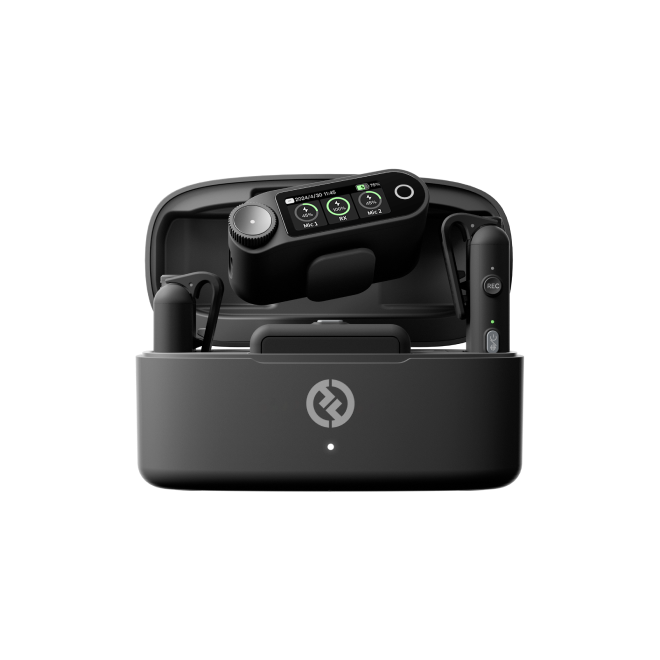
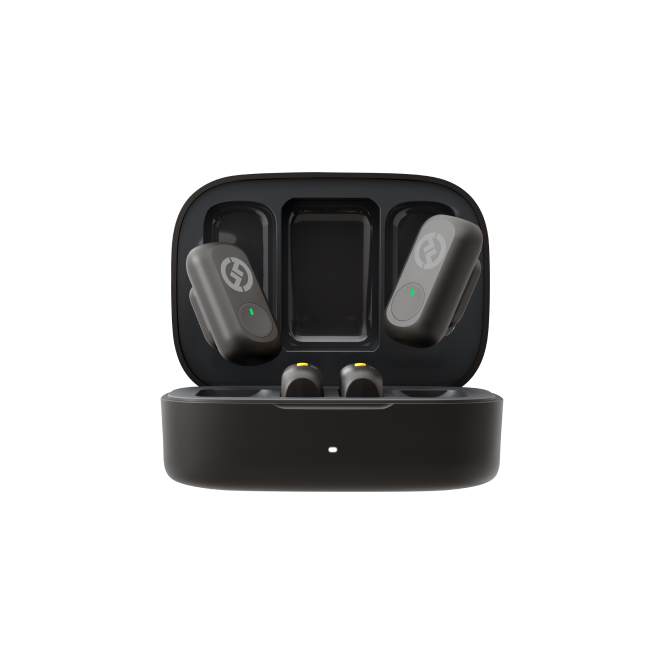
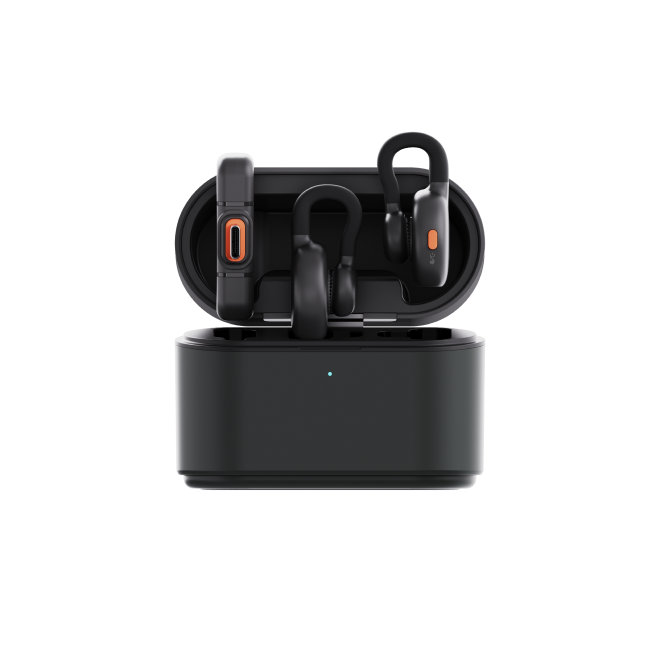
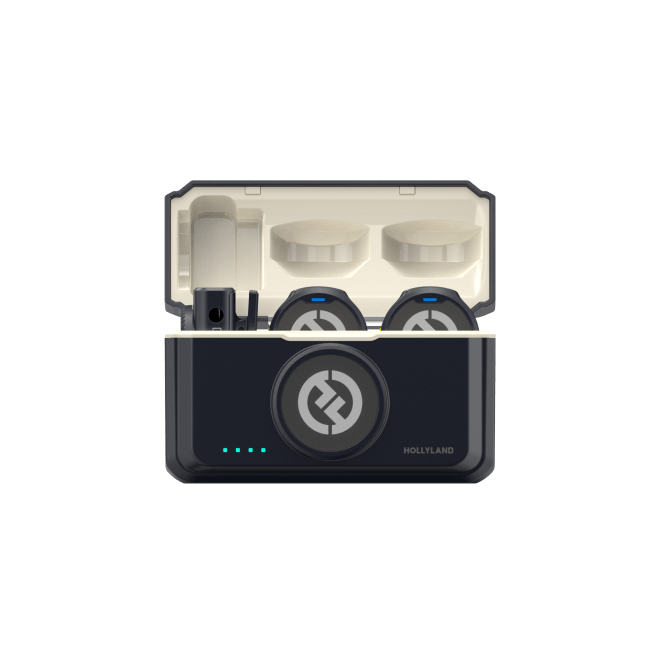
Beyond the fixed studio, 32-bit float technology has extended the hybrid mindset into mobile and field recording with meaningful practical consequences. Modern wireless microphone systems equipped with 32-bit float recording address one of the key vulnerabilities that once plagued digital capture in unpredictable environments: gain staging failure. The Hollyland LARK MAX 2, for example, features 32-bit Float Internal Recording alongside a 48 kHz / 32-bit Float audio output, which means that even in a fast-moving shoot where setting precise gain levels in advance is not practical, the recorded audio can be recovered without clipping artifacts in post-production. That kind of headroom protection once required expensive hardware workarounds and, in analog field capture, simply did not exist at all.
The hybrid workflow is not a compromise position. It is the professional standard — a practical acknowledgment that analog and digital formats have complementary strengths, and that the goal is the best possible result rather than adherence to a single format philosophy.
Which Format Is Right for You?
The right format depends on what you are trying to accomplish, what your budget allows, and what kind of working experience you want. Neither analog nor digital is objectively superior. They are different tools with overlapping capabilities and distinct trade-offs.
Choose digital if you are:
- A beginner or budget-conscious recordist: Digital has the lowest barrier to entry by a wide margin. A laptop, an affordable audio interface, and free or low-cost DAW software give you the ability to record, edit, and produce at professional quality without ongoing media costs.
- A podcaster, video content creator, or broadcaster: These workflows require portability, fast turnaround, and easy file management. Digital handles all three without compromise.
- A filmmaker or field recordist: Modern digital recorders offer strong dynamic range and plenty of headroom. Their portability also makes them practical for recording outside studios. Models with 32-bit float add extra safety against clipping. For location work, digital recording is clearly the more practical choice.
- A home studio owner focused on versatility: Non-destructive editing, unlimited tracks, and software processing flexibility make digital the foundation for most home studio work, with analog emulation plugins available whenever you want the character of tape.
Consider analog if you are:
- A professional studio engineer working in specific genres: If clients pay for tape saturation and compression in their sound, it can matter. This applies to classic rock, blues, and certain jazz styles. In those cases, adding a tape machine may be worth it. The extra gear can become part of the finished sound.
- A producer focused on a specific aesthetic: Lo-fi, noise rock, or any project where the texture of tape is a creative goal rather than a problem to solve.
- An audiophile or tape enthusiast: Listening to music on tape has a distinct experiential quality, and if the format itself matters to you as a listener, that is a legitimate reason to engage with it on those terms.
The Middle Approach:
For most working musicians, producers, content creators, and home studio owners, the answer is digital as the foundation with selective analog integration, either through hardware such as a tape machine, tube preamp, or analog compressor, or through well-chosen emulation plugins. This approach gives you the technical advantages of digital recording while preserving full access to the tonal character that makes analog distinctive when you need it.
FAQs
Q: Is analog audio actually better quality than digital?
Not objectively. Digital formats capture audio with more accuracy, wider dynamic range, and lower noise than analog tape. Analog can sound preferable in certain contexts because of the harmonic saturation and natural compression it introduces, qualities many engineers and listeners find musically pleasing. Whether that translates to “better” depends entirely on what you value in a recording and the genre you are working in.
Q: What does “analog warmth” actually mean technically?
Technically, analog warmth comes from certain types of harmonic distortion. Magnetic tape can add 3rd and 5th harmonics near saturation. Tube circuits may instead create even-order harmonic distortion. Both effects pair with gentle compression and slight high-frequency roll-off. Together, they add color that listeners hear as warm, full, and rich. Tube harmonics match octave intervals, blending smoothly with source material. Tape creates warmth by softening harsh transients through high-frequency attenuation.
Q: What sample rate and bit depth should I use for digital recording?
For video and broadcast work, 48 kHz at 24-bit is the professional standard. For music production targeting CD or streaming release, 44.1 kHz at 24-bit covers the requirements well. Use 32-bit float when recording in environments where controlling gain in advance is not reliably possible, as it eliminates the risk of destructive clipping during the capture stage.
Q: Can you use analog and digital recording together?
Yes, and most professional studios actually work this way. They often track through analog gear before going digital. That gear includes tube preamps, tape machines, and compressors. Then, everything gets converted to digital for editing and mixing. This hybrid setup is pretty standard across professional recording studios. Analog emulation plugins offer another option inside a DAW. They suit engineers who don’t have access to analog hardware. Still, results can vary depending on emulation quality.
Q: Why are some musicians and engineers going back to tape?
The return to tape is primarily aesthetic rather than technical. The saturation, compression, and harmonic character that tape produces are difficult to replicate fully with digital emulation. For some genres and producers, the sound of tape is part of the creative identity of the work itself. The tactile experience of working with a physical medium, including the constraints it imposes, is also a meaningful factor for some practitioners.
Conclusion
Analog and digital recording aren’t competing formats. Why? Because analog gives recordings a distinct character from magnetic tape physics. That includes harmonic saturation, natural compression, and organic texture. Many engineers actively choose those qualities during recording sessions. Digital offers precision, scalability, and flexibility that tape can’t match. For most people nowadays, digital makes the most practical foundation. A hybrid setup becomes more useful as skills and budgets grow. The goal isn’t choosing one format just because it’s traditional. It’s getting the strongest result for the project at hand.


Subscribe us
to get the latest news!


