.png)
 简体中文
简体中文 
How to Build an All-in-One Music Recording System at Home
You have a song idea at 11 PM. You hum it into your phone, lose the vibe by morning, and the moment is gone.
That’s the real cost of a complicated home recording setup — not money, but missed inspiration.
Most guides will tell you to buy an audio interface, a condenser mic, studio monitors, a DAW, a mixer, and a set of headphones. Stack them up, cable them together, troubleshoot for three weekends, and maybe get a decent recording. That approach works for a dedicated studio. It doesn’t work for creators, singers, and musicians who need to move fast and stay creative.
This guide is for people who want a home music recording system that actually fits their life — one that’s portable, professional-sounding, and simple enough to use without an engineering degree. We’ll walk through what you really need, what you can skip, and how modern all-in-one recording systems like the Hollyland MELO P1 are changing what “home studio” even means.
Why Most Home Recording Setups Fail Creators
The Multi-Device Problem
The traditional home recording setup is built on a stack of separate devices — each one designed by a different company, running different software, connected by a tangle of cables. Audio interface into computer. Mic into interface. Headphones into interface. Mixer somewhere in the middle. Remote somewhere across the room.
Every link in that chain is a potential failure point. And when you’re in the middle of a creative flow, the last thing you want is to stop and troubleshoot a ground loop hum or a driver conflict.
For professional studio engineers who spend eight hours a day managing that ecosystem, the complexity is worth it. For a home recording vocalist, podcaster, or live performer, it’s a creativity killer.
What You Actually Need vs. What Gets Sold to You
Here’s the honest breakdown of what a music recording setup actually requires at its core:
| What You Need | What You Often Buy Instead |
| Clean mic signal capture | Full mixing console |
| Real-time audio monitoring | Separate studio monitor system |
| Signal processing (EQ, reverb, noise reduction) | Multiple software plugins + hardware |
| Portability for different spaces | Rack-mounted gear |
| Simple control | Complex DAW workflow |
The gap between those two columns is where most beginners overspend, over-complicate, and eventually give up.
What Makes a Truly All-in-One Music Recording System
The Four Components That Actually Matter
A legitimate all-in-one recording system needs to do four things well:
1. Capture — A high-quality microphone with appropriate polar pattern and SPL handling for your use case (vocals, instruments, or both).
2. Process — Real-time signal processing including EQ, reverb, noise cancellation, and gain control — without requiring a separate computer or DAW to run.
3. Monitor — Accurate playback through earphones or speakers so you can hear yourself clearly while recording or performing.
4. Control — Intuitive adjustment of levels, effects, and routing — ideally without stopping to look at a screen.
Most traditional setups require four separate devices to accomplish this. A genuine all-in-one system handles all four in a single, integrated package.
Why Wireless Changes Everything for Home Recording
The shift from wired to wireless in music recording equipment isn’t just about convenience — it fundamentally changes how and where you can record.
With a wired setup, you’re tethered to a desk. Your mic stand is fixed. Your monitoring headphones reach exactly as far as the cable allows. Your room arrangement is dictated by cable runs.
With a fully wireless system, you can record vocals standing in the center of your room (better acoustics than near a desk), move between your living room and a treated closet without re-rigging, and perform live while monitoring in real time — all without a single cable between you and your audience.

How the Hollyland MELO P1 Redefines Home Music Recording
One Case. Four Devices. Zero Compromise.
The Hollyland MELO P1 is built around a single insight: the workflow problem in home recording isn’t about individual component quality — it’s about integration. When you have to manage four separate devices, you spend your creative energy managing gear instead of making music.
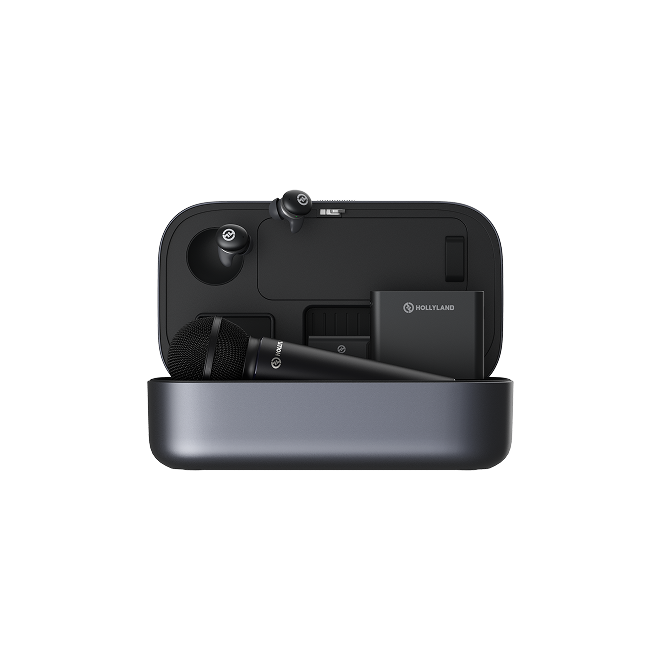
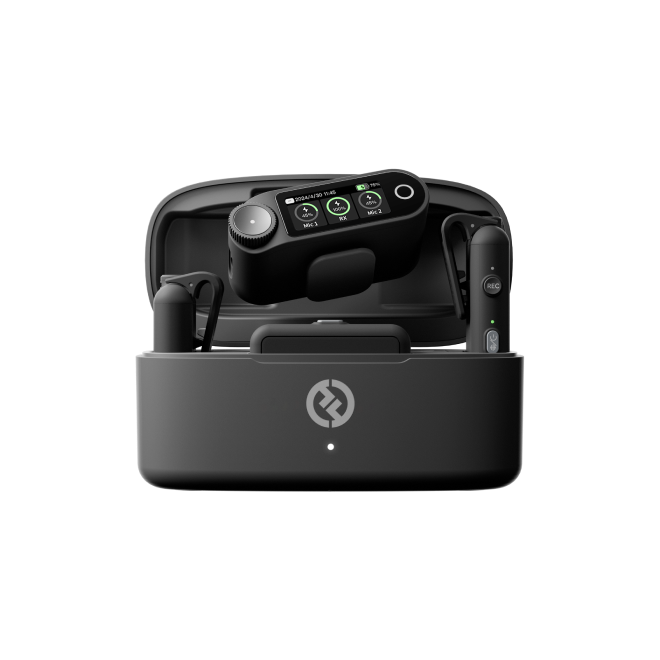
The MELO P1 solves this by combining four professional-grade components into one system:
- Smart Audio Mixer — the hub that processes, routes, and outputs your audio at 48kHz/32-bit float & 24-bit quality
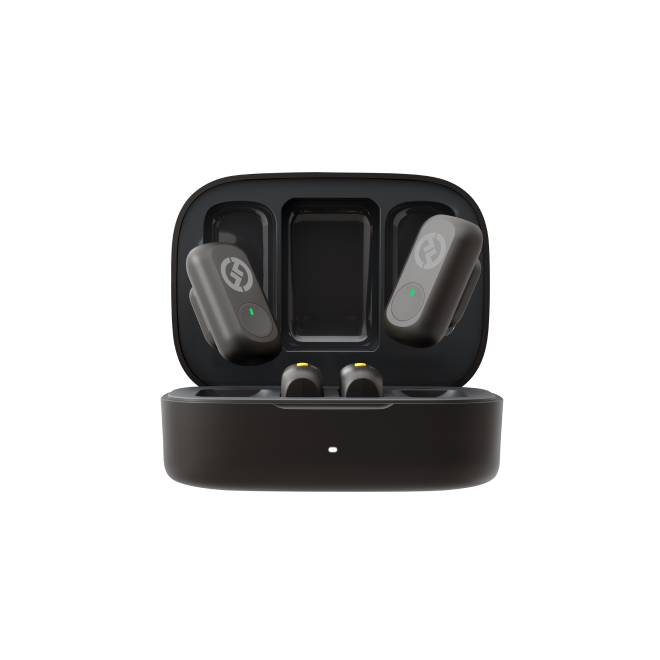
- Wireless Microphone — available in dynamic or condenser versions, with 116dB dynamic range and cardioid polar pattern
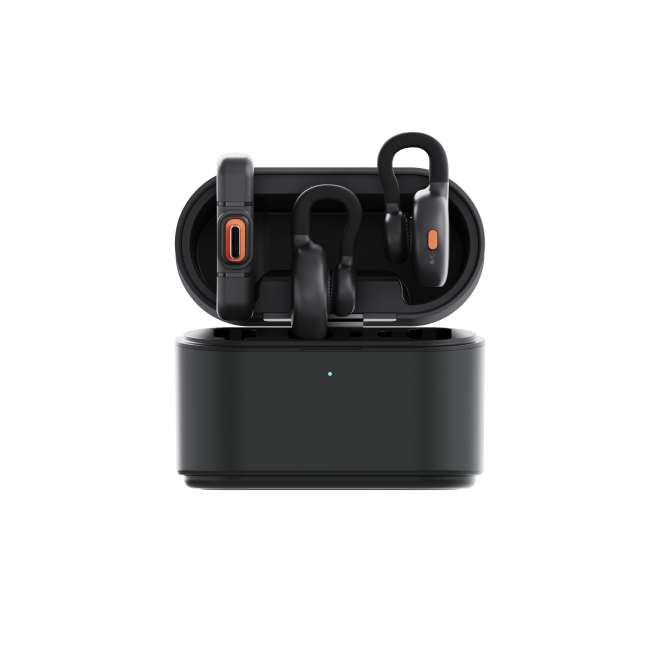
- Wireless Monitoring Earphone — IPX4-rated, 5.7g per earbud, 20Hz–20kHz frequency response
- Bluetooth Remote Control — 70m LOS range for hands-free level and reverb adjustment

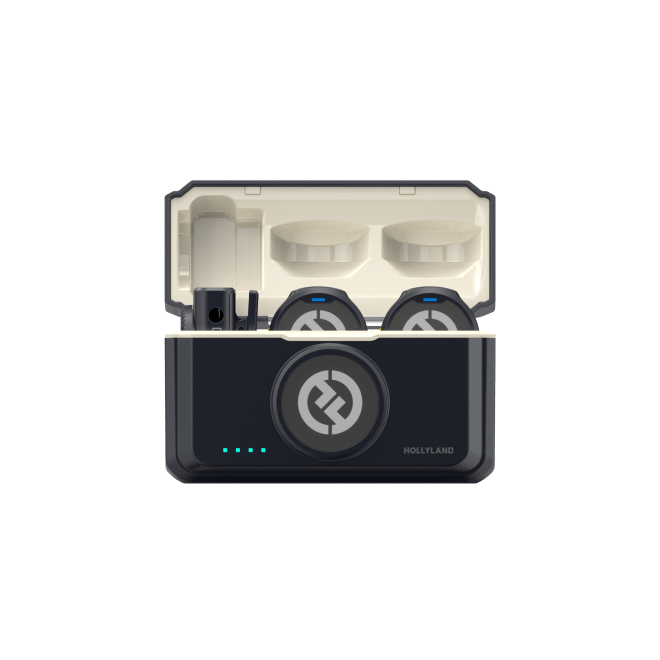
Everything charges and stores in a single 5,000mAh charging case. Pick it up, open it, and you’re recording in under two minutes.
Setting Up MELO P1 for Home Singing: Step by Step
This is where the MELO P1 experience diverges most sharply from a traditional home recording setup. Here’s the actual workflow:
Step 1: Unbox and charge.
The charging case holds the mixer, microphone, earphones, and remote. A full charge via USB-C (PD 3.0, 67W input) takes approximately 2 hours at 9V/3A. The system ships pre-paired — no Bluetooth pairing screens, no driver installation.

Step 2: Power on the Smart Audio Mixer.
The mixer powers on with a single button. It automatically reconnects to the wireless microphone via 2.4GHz (60m unobstructed range) and to the monitoring earphones. The entire pairing process happens in seconds.

Step 3: Put in your monitoring earphones.
The earphones connect to the mixer via 2.4GHz for ultra-low-latency monitoring — critical for recording vocals without the disorienting delay you get from Bluetooth-only systems. When used over 2.4 GHz, battery life extends to 9 hours.

Step 4: Pick up the mic and start singing.
The cardioid pattern focuses on your voice and rejects room noise from behind. The 25dB noise cancellation depth handles background hum, fan noise, and ambient room sound. You hear yourself clearly, in real time, through your earphones.

Step 5: Dial in your sound with the HollyAudio App.
Open the app on your phone, and access 100+ professionally fine-tuned presets organized by use case — chatting, singing, live performance. Each preset is a complete EQ + reverb + processing chain tuned by audio engineers. For home singing specifically, presets include vocal enhancement, reverb room sizes, and pitch-smoothing options that would take hours to configure manually in a DAW.

Step 6: Adjust live with the Bluetooth Remote.
While singing, use the remote (70m range) to adjust reverb volume and earphone monitoring level without breaking your performance to reach the mixer. This is particularly useful when the mixer is connected to a speaker system across the room.

Audio Quality: What the Specs Actually Mean for Singers
The MELO P1’s 32-bit float digital output deserves a specific mention for home recording users.
Standard 24-bit recording clips when your input signal is too loud — the waveform hits the ceiling and distorts in a way that cannot be repaired in post. 32-bit float recording essentially eliminates this problem. Even if you record a loud passage that would clip in 24-bit, the 32-bit float format retains the headroom to recover the signal in any modern DAW.
For home singers who aren’t constantly watching input levels while performing, this is a meaningful safety net.

The dynamic microphone handles up to 145dB SPL — comfortably above the level of even the most powerful live vocal performance. The condenser microphone tops out at 132dB SPL with a broader 20Hz–20kHz frequency response, making it the better choice for acoustic instruments and detailed vocal recording in a treated space.
Both operate at a 48kHz sampling rate, which is the standard for professional audio production and broadcast. The output is clean, detailed, and ready for mastering without additional hardware processing.
Building Your Home Recording Workflow Around MELO P1
For Solo Singers and Vocalists
If your primary use case is recording vocals at home — whether for demos, content creation, or practice — the MELO P1 condenser microphone + mixer + monitoring earphone combination is a complete signal chain.
Your workflow becomes:
- Open the charging case
- Load a vocal preset in HollyAudio
- Sing
The output from the Smart Audio Mixer’s USB-C port feeds directly into your computer as a clean, processed audio signal. Record it in GarageBand, Audacity, Logic, or any DAW — no interface needed, because the mixer is your interface.
For singers who also want to perform live or stream, the same setup works without modification. The 2.4GHz wireless microphone gives you 60 meters of range — enough to move freely around any home recording space or small venue.
For Content Creators and Streamers
The MELO P1’s Bluetooth connectivity adds a dimension that pure recording-focused systems lack. The mixer simultaneously supports:
- 2 × wireless microphones (2.4GHz)
- 1 × wireless monitoring earphone (2.4GHz)
- 1 × Bluetooth audio device (for backing track or click track playback)
- 1 × Bluetooth remote control
This means a content creator can sing over a backing track playing from their phone, monitor the mix in their earphones, record the output to their laptop, and adjust levels remotely — all simultaneously, all wirelessly, from a single device that weighs 55 grams (mixer only).
For Musicians Who Record in Multiple Locations
The portable music recording system argument for MELO P1 comes down to the charging case form factor. Everything the system needs — mixer, mic, earphones, remote — fits in a case roughly the size of a hardcover book, weighing 834g total.
This makes it practical to record in your bedroom in the morning, a rehearsal space in the afternoon, and a friend’s home studio in the evening — using the same system, the same presets, and the same quality. Traditional music recording equipment setups simply cannot do this without significant pack-down and setup time.
Frequently Asked Questions
Q: Do I need a separate audio interface with the MELO P1?
No. The Smart Audio Mixer functions as a USB audio interface. Connect it to your computer via USB-C and it appears as an audio input device in any DAW or recording software. No additional interface is required.
Q: Can I use the MELO P1 for both singing and instrument recording?
Yes. The dynamic microphone is suited for loud sound sources and live vocals. The condenser microphone captures broader frequency detail, making it appropriate for acoustic guitar, piano, and nuanced vocal recording. Both are included options in the MELO P1 system.
Q: Is there noticeable latency in the monitoring earphones?
The 2.4GHz monitoring connection is designed for real-time monitoring with minimal latency — significantly lower than standard Bluetooth. For live singing and performance monitoring, this is the recommended connection mode.
Q: How many presets does the HollyAudio App include, and can I create my own?
The app includes 100+ professionally fine-tuned presets covering singing, chatting, and broadcast use cases. The app also supports Pro Fine-tuning mode, where you can customize EQ, reverb, and processing parameters and save your own presets.
Q: What’s the total battery life of the system?
The Smart Audio Mixer runs for 8 hours on a single charge. The wireless microphone lasts 12 hours. The monitoring earphones last 9 hours (2.4G mode) or 7.5 hours (Bluetooth at 50% volume). The 5,000mAh charging case recharges all components when not in use, extending total usable time significantly beyond a single charge cycle — up to 40 hours of combined use.
Q: Is the MELO P1 suitable for outdoor recording?
Yes. The monitoring earphones carry an IPX4 waterproof rating, and the 2.4GHz wireless system maintains 60m range in open outdoor environments. The system is designed for mobile, on-location use as well as home recording.
Conclusion
The traditional advice for building a home music recording system — buy an interface, buy a mic, buy monitors, learn a DAW, cable everything together — is still valid for people who want maximum customization and don’t mind the complexity.
But for singers, creators, and musicians who want professional sound without the setup burden, the calculus has changed. An all-in-one recording system like the Hollyland MELO P1 delivers 32-bit float audio quality, real-time AI noise cancellation, wireless monitoring, and 100+ professional presets in a package that fits in a bag and sets up in under two minutes.
The best home recording setup isn’t the one with the most gear. It’s the one you actually use, every time inspiration hits.
Ready to Start Recording?
Explore the Hollyland MELO P1 — the all-in-one wireless studio built for creators who take sound seriously.
Whether you’re recording your first vocal demo or building a portable content creation rig, MELO P1 is designed to keep up with how and where you create — without the complexity that gets in the way.


Subscribe us
to get the latest news!


