




















.png)
 简体中文
简体中文 
You’re posting YouTube Shorts consistently, but the views aren’t coming. The problem usually isn’t the content itself — it’s the promotion strategy around it. YouTube’s Shorts ecosystem rewards creators who understand the algorithm, optimize before uploading, and distribute deliberately. This guide breaks down nine proven strategies to get more views on your Shorts, grow your subscriber count, and build real momentum — whether you’re starting from zero or trying to break through a stubborn plateau.
Understand How the YouTube Shorts Algorithm Works
The Shorts algorithm behaves differently from YouTube’s long-form recommendation engine, and confusing the two is one of the most common mistakes creators make.
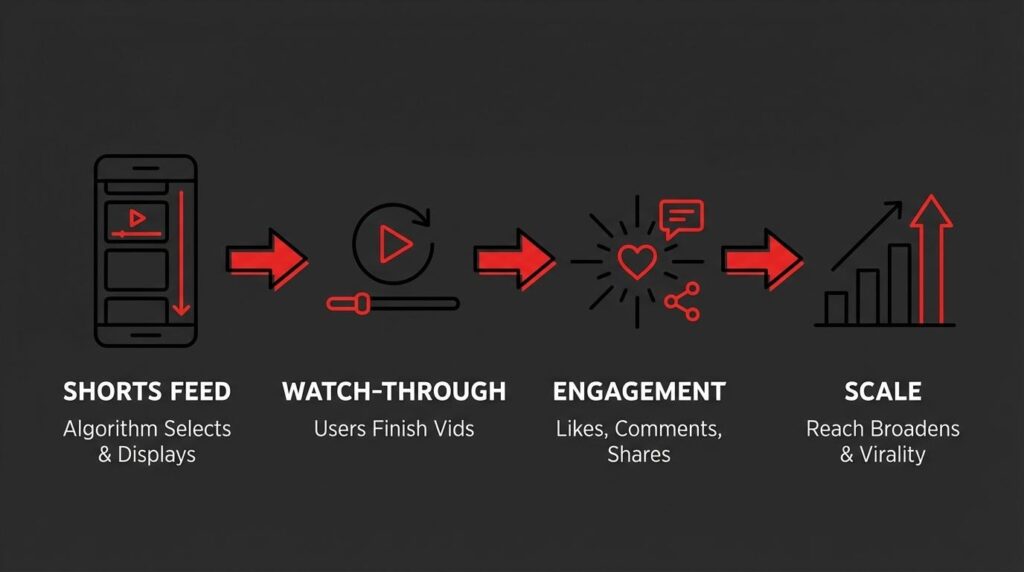
Shorts are distributed primarily through the Shorts shelf on the YouTube homepage, the Shorts tab on mobile, and the Shorts feed — a swipeable vertical format similar to TikTok. Unlike long-form videos, which are recommended based on watch history and click-through rate accumulated over days or weeks, Shorts are pushed into discovery feeds quickly and assessed almost entirely on early momentum.
The key signals the algorithm uses to decide whether to widen a Short’s distribution:
- Watch-through rate: Did viewers watch all the way to the end — or better yet, loop back and watch again? This is the single most weighted retention metric for Shorts.
- Engagement velocity: Likes, shares, and comments in the first few hours signal relevance to the algorithm.
- Subscribe actions from the Shorts feed: When a viewer subscribes directly after watching a Short, it registers as a strong quality signal.
- Swipe-away rate: How quickly viewers exit your Short functions as a negative signal. If viewers leave your Short too fast, it sends a negative signal.
The practical takeaway: Every promotion strategy in this guide improves one or more of these signals. Better hooks improve watch-through rate. Consistent posting builds engagement momentum. Promoting your Shorts across different platforms can grow traffic and help the algorithm show them more. Remember these signals when making any decisions.
Optimize Your Shorts Before You Post
Most promotion happens before you hit publish. On-platform optimization is the groundwork that determines how discoverable your Short is from the moment it goes live.
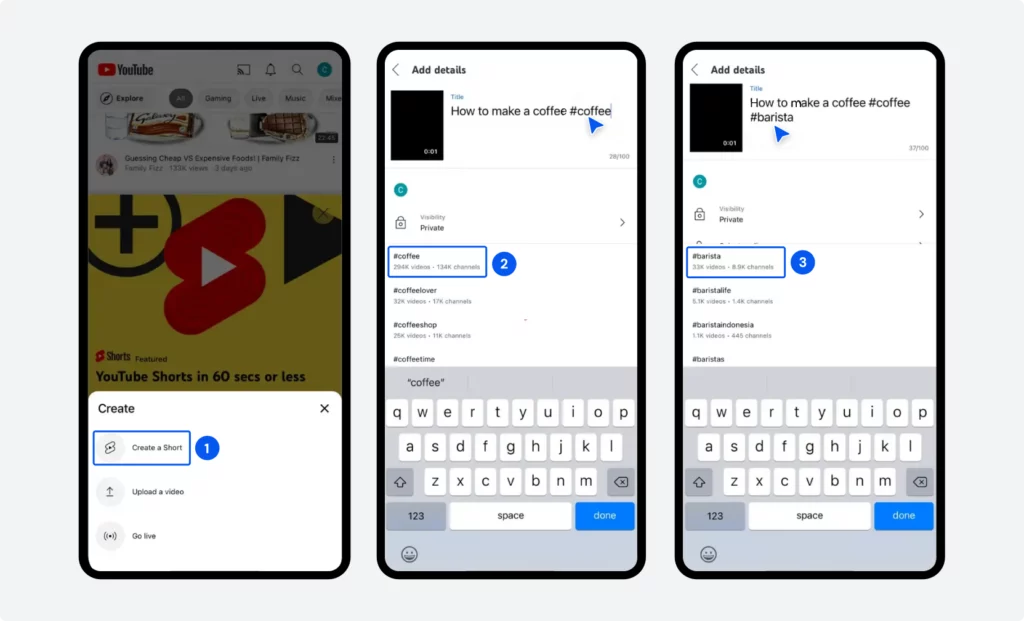
- Title — Write a title under 60 characters that includes your primary keyword naturally. YouTube indexes titles for search and displays them in Shorts search results and browse pages. They’re often the first element a potential viewer reads.
- Description — YouTube shows only the first two lines of a Shorts description without expanding. Front-load your most important keyword phrase and a clear value statement in those first two lines. Use the remaining space for supporting context or links.
- Hashtags — Add 3–5 hashtags directly in the description. Always include #Shorts. Follow with one niche-specific hashtag and one trending or topic-relevant tag where it genuinely applies.
- Thumbnail selection — Shorts auto-play in the feed, but when they appear in YouTube search results or the Shorts tab separately, a still frame is displayed. Choose a frame with a clear, expressive visual — ideally a moment with readable on-screen text or a strong facial expression.
Titles That Work for Shorts
Your title directly influences click-through rate in search and browse contexts. Weak titles are generic; strong titles create an information gap the viewer wants to close.
| Weak Title | Strong Title |
|---|---|
| My Morning Routine | I Replaced Coffee With This for 30 Days |
| Guitar Tips | The One Guitar Mistake Beginners Always Make |
| Easy Dinner Recipe | 5-Minute Pasta That Tastes Like It Took an Hour |
| Travel Packing Hack | I Fit 2 Weeks of Clothes Into a Carry-On — Here’s How |
Strong titles use curiosity gaps, bold claims, or direct how-to framing. They promise a specific payoff without fully delivering it until the viewer watches through to the end.
Hashtag Strategy That Actually Helps
Adding too many hashtags, like 20 or more, does not increase a Short’s reach. It weakens the relevance signal to the algorithm and can reduce how widely it is shown.
The effective approach:
- #Shorts — always include this one! It places your video in the Shorts content pool
- One niche hashtag — category-specific (e.g., #FitnessMotivation, #TravelTips, #CookingHacks)
- One trending or topic hashtag — only if genuinely applicable to the content
- Maximum 5 hashtags — prioritize relevance over volume
- Avoid tags like #viral or #trending — they add no placement value and signal low editorial intent
Hook Viewers in the First 3 Seconds
If viewers leave within the first three seconds, the algorithm counts it as a swipe-away and limits your Short. Getting the hook right is non-negotiable.

There are three proven hook structures that consistently drive strong watch-through rates:
1. The Direct Value Promise: State the outcome immediately — no intro, no channel sign-off, no preamble. > “Here’s exactly how to double your bench press in six weeks.”
Viewers know immediately what they’re getting. This hook works especially well for instructional and educational Shorts.
2. The Pattern Interrupt: Open with something visually or sonically unexpected — a counter-intuitive statement, an unusual setting, or a sudden movement that breaks what the viewer expected to see. > “Stop doing push-ups like this.” (Cut immediately to a demonstration of the wrong form)
The viewer is compelled to watch because something unexpected happened before they could decide to swipe.
3. The Open Loop: Pose a question or set up a scenario that can only be resolved by watching to the end. > “The mistake I made almost cost me $5,000 — here’s what happened.”
The viewer stays because the loop isn’t closed yet, and leaving feels unsatisfying.
One critical detail: Design your first frame to work without sound. A significant portion of viewers have auto-mute enabled. If your hook depends entirely on a spoken opening line over a blank or neutral visual, you’ll lose those viewers before the audio registers. Lead with a compelling visual and, where possible, mirror your spoken hook with on-screen text in the first frame.
Post Consistently at the Right Pace
The YouTube Shorts algorithm favors active channels. An irregular posting schedule — one Short this week, nothing for two weeks, three uploads the next — resets momentum. The algorithm has less data to work with and fewer recent signals to surface your content from.

For creators growing their channel with under 10K subscribers, posting 3 to 5 Shorts per week works best. This schedule is often enough to gain algorithm traction without running out of content or lowering quality.
Posting time also influences engagement velocity in the critical first hours:
- Mid-morning (8–11 AM local time) catches commuters and early mobile browsers
- Early evening (6–9 PM local time) captures post-work and post-school viewing windows
- Tuesday through Thursday typically outperform weekend posting for how-to and informational content
Use YouTube Studio’s scheduling feature to maintain consistency without posting in real time. Batch-record several Shorts in one session, schedule them across the week, and preserve a steady publishing rhythm even during busy periods.
The goal isn’t raw output volume — it’s consistent signal quality. One well-optimized, well-hooked Short beats seven rushed uploads with no clear value proposition.
Use Trending Audio to Boost Discovery
YouTube’s algorithm surfaces Shorts in part through audio discovery. When a trending sound gains momentum, YouTube groups Shorts using that audio together — meaning your Short can be recommended alongside high-performing videos that share the same track. It’s one of the fastest organic discovery levers available to any creator.

How to find trending audio: Open a competitor’s Short in your niche, tap the audio name at the bottom of the screen, and view how many Shorts are using it and whether that number is trending upward. You can also browse the YouTube Sounds library inside YouTube Studio, where trending tracks are flagged. Patterns within a niche emerge quickly after a few sessions of competitive research.
Original audio vs. trending tracks: Using trending audio increases initial discoverability by placing your Short in an active audio feed. But original audio has its own compounding advantage — if your Short Short becomes popular, the original audio will be credited to your channel. When other creators use it, the audio connects back to your content through the discovery system.
The key factor: Audio quality on the original audio directly determines whether viewers stay through to the end.
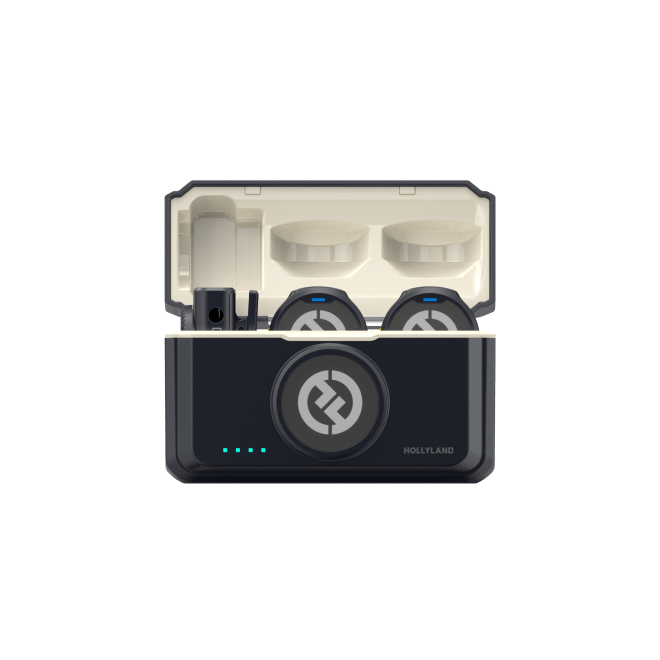
Pro Tip: For creators recording direct-to-camera narration or voiceover, muffled or echo-heavy audio is one of the fastest ways to trigger swipe-offs — even when the visual content is strong. A compact wireless mic like the Hollyland LARK M2 (9g, coin-sized, up to 40-hour battery) lets you capture broadcast-quality audio without slowing down a Shorts filming session. For active or outdoor content, the LARK M2S adds a reinforced titanium clip designed for movement-heavy setups.
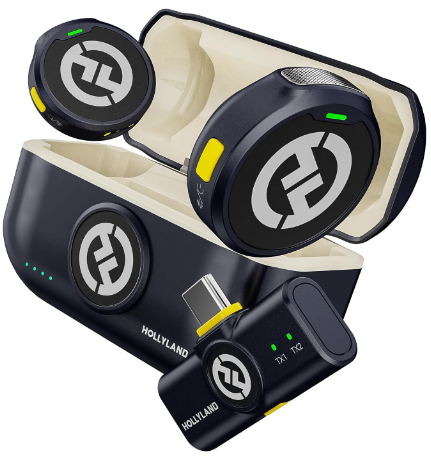
Hollyland LARK M2 - Mini Lavalier Microphone
An incredibly lightweight and compact wireless button microphone that captures high-fidelity audio.
Key Features: 9g Button Size | 48 kHz/24-bit | 40 Hours Battery
Cross-Promote Your Shorts Beyond YouTube
YouTube’s algorithm gives your Short an initial push. But bringing in outside traffic shows it has wide interest, which can help it reach more viewers faster. Cross-promotion is the highest-leverage action you can take outside of platform optimization.

The three most effective external channels:
- Instagram Reels — Repurpose your Short directly to Reels, but remove the YouTube watermark first. Instagram’s algorithm suppresses watermarked content in its recommendation feed. Add a CTA in the caption directing followers to your YouTube channel, or link to the Short via a link-in-bio tool. Reels reach a heavily overlapping audience and require essentially no additional production effort.
- TikTok — Same principle: same vertical video, same format, watermark removed. TikTok reaches a partially distinct audience that can be funneled back to YouTube through consistent content presence. Engage with TikTok comments rather than just posting and disappearing — platform-native interaction builds trust that converts to YouTube subscribers over time.
- YouTube Community Posts and long-form video cards — Pin your latest Short as a Community Post on your YouTube channel homepage to drive warm traffic from existing followers. Inside long-form videos, add a Shorts card at a natural pause point, directing viewers to related short content. This is your highest-conversion traffic source because the audience already trusts you.
Additional channels worth a mention: if you maintain an email newsletter, a weekly “what’s new on Shorts” link adds consistent, low-effort traffic. Sharing Shorts in niche-specific Reddit communities — where the content is genuinely relevant, and self-promotion is permitted — can also drive bursts of targeted external traffic.
Engage the Community to Accelerate Reach
Engagement signals tell the algorithm your Short is generating genuine interaction, not passive scrolling. This directly influences continued distribution beyond the initial push.
- Reply to every comment within the first 24 hours. YouTube notifies commenters when the creator replies, pulling them back into the video and generating additional engagement signals at a critical distribution window.
- Pin a question-based comment immediately after publishing. Something like “Which tip surprised you most?” or “Have you tried this — what happened?” consistently outperforms generic CTAs and starts a visible thread that encourages new viewers to contribute.
- End every Short with one specific CTA — not three. Ask a question (drives comment engagement), ask for a like (best for entertaining Shorts where you delivered on a clear promise), or direct to subscribe (best when you’ve clearly established value). Stacking multiple CTAs at the end dilutes all of them.
- Avoid manufactured engagement prompts like “Comment ‘DONE’ if you watched to the end.” YouTube has become more effective at identifying low-quality engagement patterns and deprioritizes content relying on them.
Genuine interaction builds up over time. Channels with consistent comment activity build a visible community signal that encourages new viewers to participate rather than scroll past.
Collaborate With Other Shorts Creators
Collaborations are one of the fastest ways to reach an engaged, niche-aligned audience without paid promotion. When another creator’s audience discovers your content through a trusted source, the conversion rate to subscribers is significantly higher than cold, algorithm-driven discovery.

Practical collaboration formats for Shorts include: appearing in another creator’s Short (Q&A snippet, challenge format, or brief reaction), coordinated posting where both creators publish related Shorts on the same day and reference each other naturally in comments, and cross-channel shoutouts embedded within content rather than posted as standalone promotional videos.
When choosing collaborators, focus on niche fit rather than subscriber count. A creator with 5,000 highly engaged subscribers in your exact niche will generate more meaningful growth than a 100K generalist whose audience has minimal overlap with your content. Before you reach out, review engagement levels. Look at the likes-to-view ratio and comment activity to see if the audience is truly active.
Outreach quality matters too. Come with a specific, concrete collaboration idea rather than a vague “want to collab?” message. Creators respond significantly better when they can immediately visualize the format, time commitment, and mutual benefit.
Use YouTube Analytics to Promote Smarter, Not Harder
Every promotion decision should be informed by what your data is already telling you. YouTube Studio’s Shorts-specific analytics reveal exactly which elements are working and which are actively costing you distribution.
| Metric | What It Tells You | Action to Take |
|---|---|---|
| Average Percentage Viewed | How much of your Short the average viewer actually watch | If below 70%, your hook or mid-video pacing is losing viewers — audit the first 3 seconds and look for pacing drop-off points |
| Swipe-Away Rate | The percentage of viewers who exit immediately after the Short starts | High swipe-away indicates a weak first frame or a mismatch between title and content — A/B test different hooks across similar Shorts |
| Traffic Source | Where viewers are finding your Short (Shorts feed, search, browse, external) | If traffic is almost entirely feed-driven, prioritize cross-promotion; if search traffic is low, revisit title keywords and description optimization |
| Subscriber Gain per Short | How many new subscribers does each individual Short generate | Identifies which content themes convert passive viewers to subscribers — double down on those topics and formats |
Review these metrics weekly rather than daily. Single-day fluctuations are misleading and invite reactive rather than strategic decisions. Look for patterns across 4–6 consecutive Shorts and use that data to make intentional adjustments to your next batch.
Frequently Asked Questions
Do hashtags actually help promote YouTube Shorts?
Yes — #Shorts specifically signals to YouTube which content pool to surface your video from. Niche hashtags help you appear in hashtag browse feeds. The key is relevance and restraint: 3–5 targeted hashtags consistently outperform 20+ generic ones. After 5 or 6 hashtags, the benefit drops quickly, and the relevance signal becomes weaker.
How often should I post YouTube Shorts to see growth?
3–5 Shorts per week is the effective range during a growth phase. Consistency signals an active channel and gives the algorithm more data points to work with. Irregular posting, even with strong Shorts, breaks momentum. It also stops the algorithm from forming a steady distribution pattern for your channel.
Can YouTube Shorts grow my main channel?
Yes, though indirectly. Shorts drive subscribers who may not immediately watch long-form content, but they establish your authority in a niche quickly. Use Shorts to deliver fast, targeted value on topics you cover in depth elsewhere, then direct engaged viewers to related long-form videos to deepen the relationship over time.
Should I post my Shorts on TikTok and Instagram too?
Yes — cross-posting with the YouTube watermark removed gives you multi-platform reach without creating new content. Removing the watermark is critical: both TikTok and Instagram algorithmically suppress watermarked content in their recommendation feeds. Ensure the Short is vertical, ideally under 60 seconds, and feels native to each platform’s style.
How long does it take for YouTube Shorts to get views?
Shorts can gain traction within hours or take several weeks, depending on niche saturation, hook strength, and algorithm timing. Most Shorts see their peak distribution window within the first 7 days of publishing. Consistent posting reduces dependence on any single Short’s performance. Each new upload is another opportunity for the algorithm to surface your channel to new audiences.
Conclusion
Promoting YouTube Shorts works like a compounding system. Prepare before posting, grab attention in the first three seconds, post at a steady pace, share across platforms, and let analytics guide your next step. Before filming your next Short, audit your last five against this framework. Identify the weakest link in the chain and fix that first. Small, consistent improvements stack into measurable growth faster than any single viral moment ever will.