.png)
 简体中文
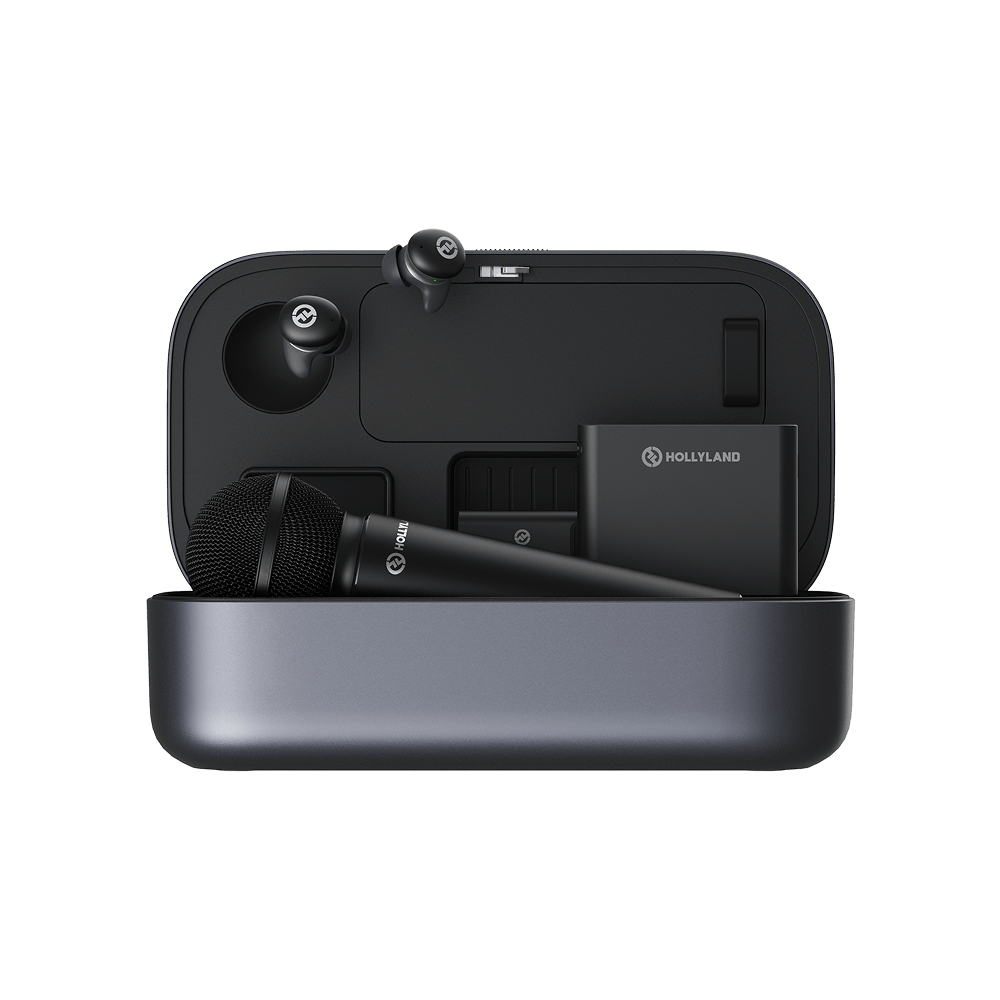
MELO P1
Record, Stream & Perform — Fully Wireless
- 32-Bit Float / 48kHz
- 25dB AI Noise Cancellation
- Up to 40H Battery Life

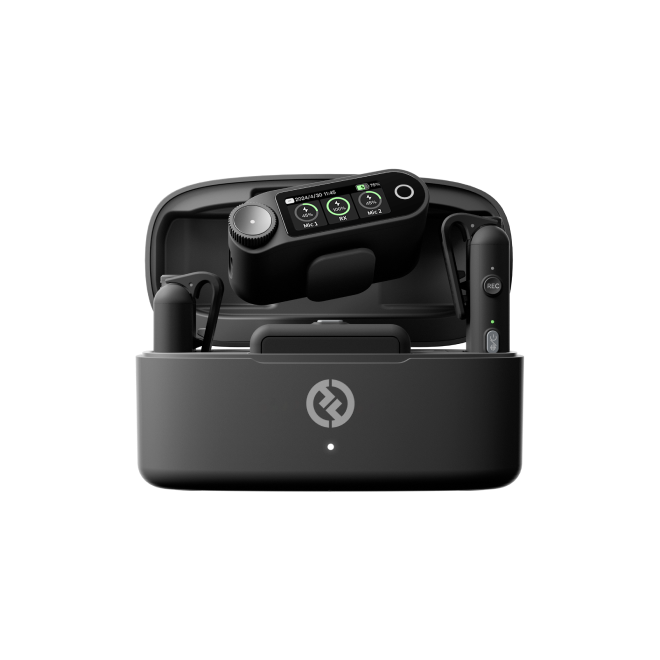
Professional studio microphone quality no longer requires a fixed room or complicated rig. Hollyland's wireless studio microphone system combines large-diaphragm condenser capture, 32-bit float recording, and AI noise cancellation — all in one portable, cable-free setup for recording, streaming, and live performance.
For recording, streaming, live performance & podcasting — no audio interface required.
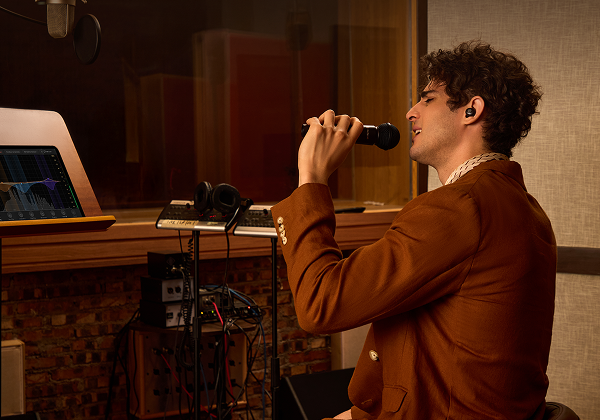
Record, Stream & Perform — Fully Wireless
The capsule is the heart of any microphone — and the choice between condenser and dynamic shapes everything from tonal character to how the microphone handles loud environments.
Condenser microphones use a thin, electrically charged diaphragm to capture sound with exceptional sensitivity and detail. They respond to fine nuances in tone, breath, and texture, making them the preferred choice for:
n- Vocal recording, harmonies, and singing
n- Voiceover, audiobook narration, and spoken word
n- Acoustic instruments with wide frequency ranges
n- Podcasting and broadcast where tonal clarity is the priority
Dynamic microphones use a moving-coil mechanism that handles extremely high sound pressure levels without distorting. They're better suited for:
n- Live performance and high-energy stage environments
n- Intense vocal styles like beatboxing, shouting, or rap delivery
n- Louder environments with less acoustic treatment
A note on capsule size: Larger diaphragms — typically 25mm or above — capture more sonic detail, a wider frequency range, and more natural tonal character. If vocal fidelity is your priority, a large-diaphragm condenser is the place to start.
Some systems offer a swappable capsule design, giving you both condenser and dynamic modes in a single microphone body — a practical advantage for users who record in the studio and perform live.
Traditional studio microphones rely on XLR cables, audio interfaces, and often a separate mixer. That signal chain performs reliably in a fixed studio setup — but becomes a meaningful limitation the moment you need to move around a stage, record in different locations, or go live without a dedicated setup area.
If wireless is part of your workflow, evaluate these factors closely:
The recording format determines how accurately your microphone captures the full dynamic range of a performance — and how much flexibility you'll have when editing afterward.
Not everyone records in a professionally treated studio. If you're working in a bedroom, a café, backstage, or on location, background noise handling becomes one of the most important specs to evaluate.
What to look for:
n- AI-powered noise cancellation — real-time, hardware-level noise reduction that processes the signal at source, before it reaches your recording or stream
n- Cancellation depth (dB) — The higher the number, the more aggressively background noise is attenuated; 25dB or above is effective for most real-world environments
n- Cardioid polar pattern — A directional pickup pattern naturally rejects sound from the sides and rear, reducing room noise and ambient bleed without any additional processing
Noise cancellation handled at the hardware level is generally more effective and reliable than software-based post-processing — particularly during live streaming and on-stage performance where you have no opportunity to clean up the audio afterward.
This is one of the most overlooked factors for first-time buyers. A professional-sounding result depends not just on the microphone itself, but on the entire signal chain behind it.
A traditional studio microphone setup typically requires:
n- The microphone (XLR output)
n- An audio interface to convert the analog signal to digital
n- A mixer for real-time level and EQ control
n- A monitoring device (headphones wired into the interface)
n- Cables connecting all of the above
An all-in-one integrated system combines the microphone, audio processing, and monitoring into a single portable unit — removing the need to source, learn, and maintain multiple pieces of gear. For most content creators, streamers, and live performers, this dramatically reduces both upfront cost and operational complexity.
The right choice depends on your workflow. If you already own a full studio rig and record exclusively in a fixed space, a traditional large-diaphragm condenser paired with a quality interface remains a proven path. If you want studio-grade results across multiple environments — at home, on stage, and on location — look for a system designed to perform anywhere without rebuilding the setup each time.
Zero-latency monitoring — hearing your own voice through an earphone as you perform or record — is critical for pitch accuracy, confident delivery, and catching audio problems before they enter your recording.
What to look for:
n- Zero-latency confirmation in specs — not just "low latency," which can still introduce a perceptible delay during performance
n- Wireless earphone integration — if your microphone system is wireless, a wired monitor reintroduces a cable dependency and partially defeats the purpose of a wireless setup; a fully wireless monitoring solution preserves the freedom of the whole system
Building a polished, broadcast-quality sound from raw microphone input requires EQ, compression, de-essing, reverb, and other processing tools that can take years to master from scratch.
Modern studio microphone systems increasingly offer:
n- Onboard DSP processing — signal processing handled at the hardware level by a receiver or mixer unit, delivering a finished sound without a laptop or external software
n- App-controlled presets — genre-tuned, professionally mixed vocal presets accessible from a smartphone app; an effective shortcut to a polished sound for users without deep audio engineering knowledge
n- Real-time effect control — the ability to switch vocal characters, add reverb, or adjust levels mid-performance without breaking focus or touching a separate device
For content creators, podcasters, live streamers, and performers who want professional sound without a technical background, onboard DSP and a well-designed preset library make a significant practical difference to the finished result.
For fixed studio use, battery life is rarely a concern — traditional microphones draw power from an audio interface via XLR phantom power. But for live performance, streaming, field recording, and content creation on the move, battery life becomes a core operational specification.
Practical benchmarks to evaluate:
n- Microphone battery per charge — Aim for 8 hours or more for full-day events or extended recording sessions without interruption
n- Total system battery life — If the system includes an earphone, mixer, and charging case, evaluate the combined runtime, not just the microphone alone
n- Weight — A handheld microphone held for hours on stage should stay below 350g; a portable mixer or receiver should be light enough to clip to clothing without discomfort
| Use Case | Key Factors to Prioritize |
|---|---|
| Home / studio recording | Large-diaphragm condenser, bit depth, low self-noise, frequency response |
| Live streaming | Setup simplicity, noise cancellation, zero-latency monitoring |
| Live performance | Wireless range, battery life, high SPL handling, real-time effect control |
| Podcasting / voiceover | Clarity, consistency, portability, easy setup |
| Field / on-location work | AI noise cancellation, wireless range, portability, ruggedness |
I love my new LARK M2 mics. These were so good, and I really enjoyed testing out the new LARK M2 from Hollyland.
Sarah Grace Tech Creator · 3.2M YouTube subscribers
The Hollyland LARK MAX is the wireless microphone system with the clearest and crispest audio of any wireless mic system I have ever tried.
Goenrock Cinematographer · 107K Instagram subscribers
LARK MAX is doing an excellent job of dropping the sound of the air conditioner, which is something l always have to remove and post with our shotgun mic.
Film Riot Filmmaking Educator · 2.2M YouTube subscribers
Yes — and in some ways, it exceeds it. The MELO P1 is built around a 25mm large-diaphragm condenser capsule, the same capsule format used in professional recording studios. It captures a full 20Hz–20kHz frequency range with a 116dB dynamic range and records at 32-bit float / 48kHz — a higher-resolution format than many dedicated audio interfaces output. The difference between the MELO P1 and a traditional studio rig isn't audio quality. It's that the MELO P1 removes the cables, the interface, and the mixer entirely, while matching or exceeding the capture specs of a comparably priced wired setup.
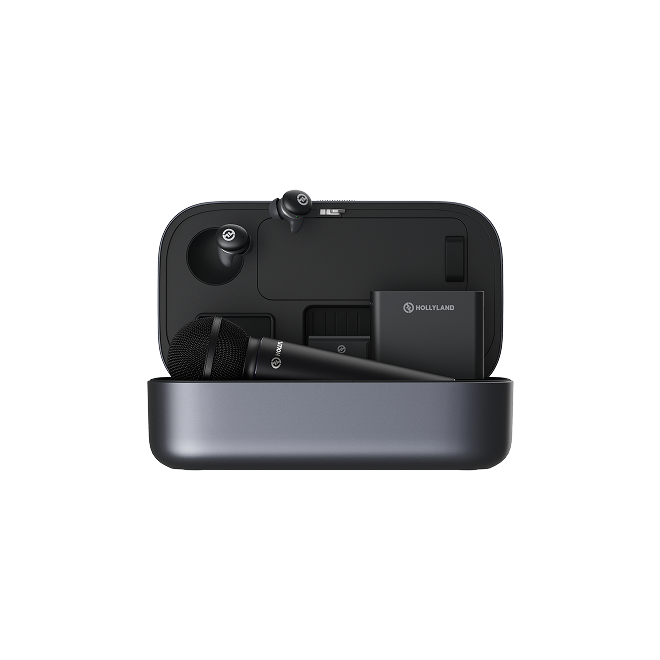
No. The MELO P1 is a complete, self-contained system. Its 55g Smart Audio Mixer acts as both the wireless receiver and a full DSP mixing unit — handling signal processing, effects, monitoring output, and USB-C connection to your recording device or streaming platform. There's no need for a separate interface, mixer, XLR cable, or monitor amplifier. Everything you need to capture, process, monitor, and output studio-quality audio ships together in a single charging case.
No. The MELO P1 uses a dedicated 2.4GHz audio transmission system with a 60m (196ft) line-of-sight range — an independent wireless channel engineered specifically for audio reliability, not repurposed consumer Bluetooth. The monitoring earphone uses a separate 2.4GHz return feed, delivering genuinely zero-latency real-time monitoring. The Bluetooth remote controller operates on a third independent channel at 70m range. All three wireless functions run on separate channels, keeping them interference-free even in crowded RF environments like live venues and convention floors.
The microphone runs approximately 12 hours per charge. The Smart Audio Mixer runs approximately 8 hours. The monitoring earphone runs approximately 9 hours. The 5,000mAh charging case extends total system battery life to up to 40 hours — so you can recharge components between sets or sessions without ever plugging into a wall outlet. For a full-day event, a back-to-back content shoot, or a multi-set live performance, the MELO P1 is built to last without interruption.
Yes — the MELO P1 is specifically engineered for both. For studio recording and streaming, the 25mm large-diaphragm condenser capsule delivers the tonal detail and dynamic sensitivity that professional vocal capture demands. For live performance, the swappable dynamic capsule handles extreme stage dynamics at up to 145dB SPL without clipping. The 60m wireless range gives you full freedom of movement on stage, the Bluetooth remote lets you switch presets mid-performance without approaching the mixer, and the wireless monitoring earphone completes a fully cable-free stage setup. One system, every scenario.
Yes. The MELO P1 uses hardware-level 25dB AI noise cancellation — processed onboard in real time, not applied as a software filter in post-production. Combined with the cardioid polar pattern, which naturally rejects off-axis sound sources, the microphone maintains a clean, focused vocal signal in environments that would expose a standard condenser capsule. Whether you're recording in a bedroom with HVAC noise, streaming from a busy shared space, or performing in a loud venue, the onboard AI is built to handle real-world conditions — not just acoustically treated studios.
No. The HollyAudio App includes 100+ professionally tuned presets spanning a wide range of vocal styles, genres, and use cases — from broadcasting and podcasting to live performance and music recording. Each preset is engineered to deliver a polished result without any manual EQ or compression adjustment. If you want to go deeper, the full effects chain — including EQ, compression, de-esser, reverb, and more — is available in the app. But for most users, selecting a preset and pressing record is all it takes to achieve broadcast-quality audio.
32-bit float is a recording format that captures an extraordinarily wide dynamic range — wide enough that it essentially eliminates clipping and gain-staging errors entirely. With a traditional 24-bit recording chain, setting your input gain too high results in a distorted take that can't be recovered in post. With 32-bit float, even a signal that was too hot at capture can be corrected after the fact without any quality loss. For live recording, field interviews, or streaming — where you can't always monitor and adjust gain in real time — this is a genuine safety net that protects every single take, automatically.